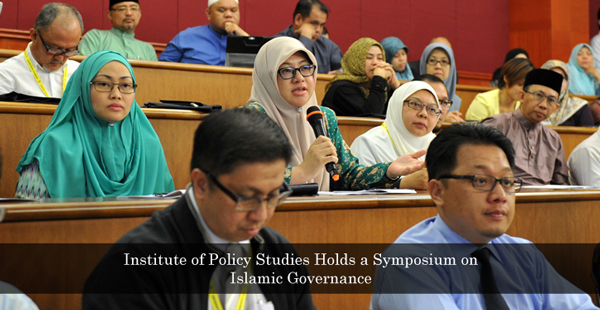
The Institute of Policy Studies (IPS) held a one-day symposium on Islamic Governance on 21 November, attracting over 100 academics, policy makers and Islamic Studies experts to the Senate Room, in the Chancellor Hall.
An Islamic system of governance provides the mechanisms and processes that are driven towards achieving the objectives of the Shari’ah. Islamic governance seeks a universal objective to create an environment of peaceful co-existence among all members of society regardless of their faiths to allow a nation to grow in harmony and prosperity.
Themed “Functionality and Relevance in a Modern Negara”, the symposium featured dynamic academic dialogues with experts in the field to cover a wide range of topics surrounding Islamic Governance such as Governance in a Contemporary Islamic Negara (country), Approaches in Islamic Public Sector Management, and Theorising Islamic International Relations, among other interesting topics. The topics were covered by experts in the country such as Amin Abdul Aziz, Adjunct Professor at IPS; and Yung Mei Chee, special duties officer at the Ministry of Energy and Industry, Prime Minister’s Office of Brunei Darussalam.
The symposium received positive feedback from the audience, who shared that it has shed light and clarity on Islamic Governance and national policies for Brunei Darussalam – a Malay Islamic Monarchy – in line with the teachings of Islam to ensure peace and stability within a country.
Major Christian James from the Royal Brunei Armed Forces shared at the symposium that the peace and inclusive environment in Brunei Darussalam reflects the success of Islamic governance and policies in creating a safe and inclusive haven for all walks of life.
“Firstly, this is probably the first country I have been in where I have complete and utter safety, and you feel inclusive in an environment, which is very rare in any country,” he said.
“Secondly, if we look at the recent activities that has happened in Paris, France, there is nothing in Brunei that has illustrated or indicated that people are afraid or anxious, and I think that is a reflection of how successful Brunei Darussalam’s policies and Islamic Governance is working.”
Dato Paduka Abdul Rahman Mohiddin, a retired government official, said that the symposium created better understanding of the maqasid of the Shari’ah to allow for the articulation of the Islamic public administration or management in Brunei that promotes peace and harmonious co-existence among people. He highlighted that protection of the dhimmis or the non-Muslims are not only guaranteed in the Constitution but also in the Maqasid of the Shari’ah; preservation of faith for both Muslims and non-Muslims. Thus all should feel very secure and protected in Brunei.
Norashikin Yusof from Sultan Hassanal Bolkiah Institute of Education (SHBIE) shared that she gained valuable insights on the key performance indicators (KPIs) of measuring taqwa. She added that previously she was unaware of the KPIs therefore now perhaps the whole nation can ‘mushasabah’ or self-reflect on how to be a better Muslims based on them.
UBD, through IPS, is currently the only university in the world that offers a Master and PhD programme with concentration in Islamic Governance: the Master of Public Policy and Management (MPPM). The MPPM is an 18-month graduate programme, conducted in partnership with top public policy schools in the USA, Georgetown University, University of Maryland, Duke University and University of California, Berkeley.