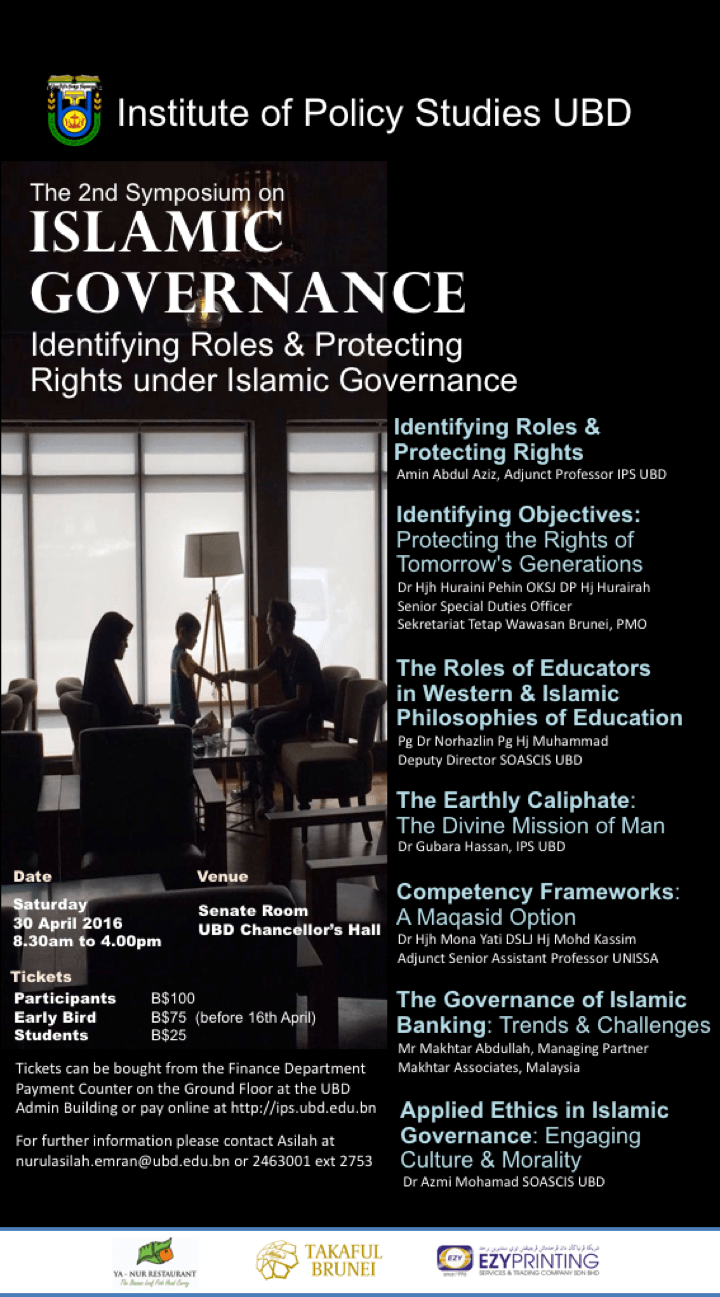
30th April 2016
The conceptualisation of Islamic Governance as an analytical framework functions as a notional map for understanding, defining and formulating processes that can lead towards creating a society conducive for the worship of Allah. And where ‘worship’ encompasses all forms of worship, both the personal devotional forms as well as the social and political. Articulating those processes in light of Islamic Governance is but one challenge faced by contemporary Muslim societies.
Key to the efficacy of all systems and processes is the human agency: how people participate and subscribe to those processes is very much dependent on the roles within which they play towards achieving the objective of an Islamic system of governance. This Second Islamic Governance Symposium organised by the Institute of Public Policy UBD will discuss the identification of those roles while protecting certain rights established under Islamic Governance.